Bengali Food in Bengaluru: A Journey from Kolkata to the Garden City
How the food of Bengal travelled south, what changed on the way, and where to find the real thing in the Garden City today.

There is a moment that repeats itself in Bengaluru every October. A queue forms outside a pandal somewhere off Thanisandra Main Road, or in Koramangala, or in Ulsoor, and it is not for the idol. It is for the bhog. People who have been in this city for fifteen years stand in line for khichuri and labra served on a shal-pata plate, and for twenty minutes the traffic outside stops mattering.
Bengali food travelled to the Garden City the way most food travels: in the luggage of people who could not do without it. What is interesting is what happened after it arrived.
This is a long piece about how Bengali food works, why it took root here, and what to look for if you want to eat it properly in Bengaluru — whether that means a plate at a restaurant, a full spread at home, or Bengali catering for two hundred guests.
What people mean when they say “Bengali food”
Ask ten people in Bengaluru to name a Bengali dish and eight will say fish curry. They are not wrong, but it is a bit like naming a single note and calling it a raga.
Bengali cooking is organised around sequence. A proper meal is not a collection of dishes competing for the same plate; it is an order, eaten one course at a time, each course preparing the mouth for the next. This is the single most important thing to understand about it, and the thing most menus outside Bengal quietly drop.
The order of things
A full Bengali meal moves roughly like this. Something bitter opens it — shukto, or a plain neem-begun — on the logic that the bitter course wakes the palate and settles the stomach before richer things arrive. Then dal with a fry alongside, usually something thin and crisp: begun bhaja, alu bhaja, a slice of pumpkin in a whisper of batter. Then the vegetable course, then fish, then meat if the occasion warrants it, then chutney, then papad, then sweets, then paan.
Nobody eats all of that on a Tuesday. But the skeleton is always there, and a Bengali eating a four-dish weeknight dinner is still eating a compressed version of the same order. When a caterer serves the fish before the dal, or skips the bitter opener at a wedding, a Bengali guest notices in the way you notice a wrong note in a familiar song. They may not complain. They will remember.
The dishes are the vocabulary. The sequence is the grammar. You can learn the words and still not speak the language.
Rice is not a side dish
In much of India, rice is what you eat the curry with. In Bengal, it is closer to the reverse: the rice is the meal and everything else is arranged around it, in small quantities, to be mixed in a few mouthfuls at a time.
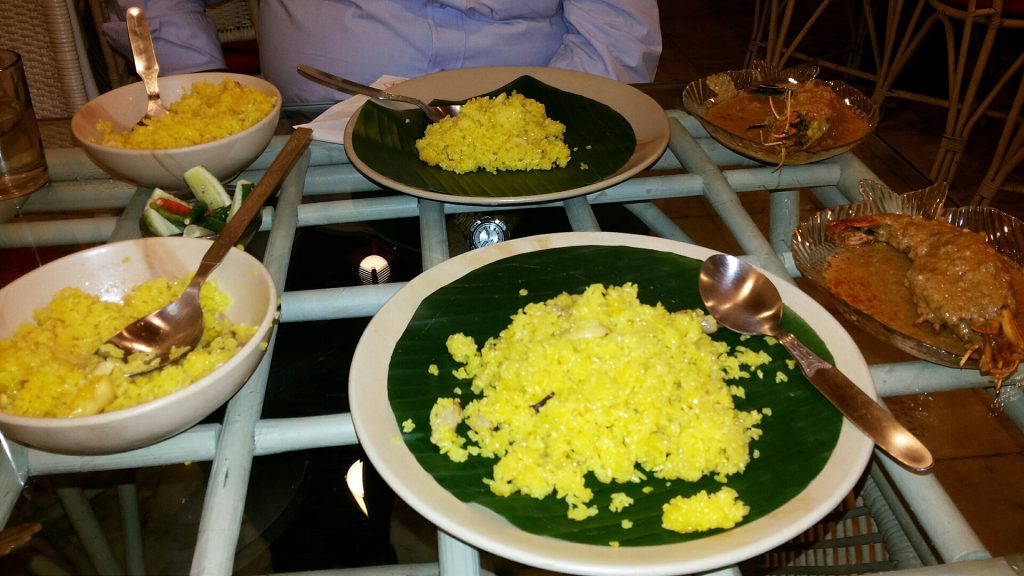
This changes the maths of a Bengali spread completely. Portions of individual dishes are smaller than a North Indian buffet would suggest, but there are more of them, and the rice has to be good. Gobindobhog for a ceremonial lunch, plain long-grain for a working weekday, basanti pulao — yellow with turmeric, sweet with ghee and raisins — when there is something to celebrate.
The mustard question
Mustard runs through Bengali cooking in two forms and people outside Bengal often conflate them. There is mustard oil, the cooking medium, pungent and sinus-clearing when raw and much gentler once it has been heated to smoking. And there is shorshe bata, a paste of ground mustard seeds used as a sauce base, which is a different and far sharper thing.
Shorshe ilish — hilsa in mustard — is the dish that makes converts and the dish that occasionally makes enemies. The paste has to be ground with green chilli and a pinch of salt and used the same day, or it turns bitter in a way no amount of sugar will rescue.
How Bengali food actually reached Bengaluru
Food follows work. Bengali food came south with the people who came south for work, and it arrived in three overlapping waves.
The engineers
The first substantial wave was professional. Through the 1990s and 2000s, a generation of Bengali engineers, analysts and academics moved to Bengaluru for jobs that did not exist in Kolkata. They came in their twenties, they cooked badly at first, and they spent a decade quietly building the supply chain they needed: a fishmonger who would clean rohu properly, a shop that stocked gobindobhog rice, someone’s mother’s recipe for posto that finally worked at this altitude.
The puja map
The second wave was social. Durga Puja is the load-bearing wall of the Bengali calendar, and a community that can organise a puja can organise anything. Bengaluru now has dozens of pujas across the city, and each one needs to feed several hundred people for four days running.
That single requirement did more for Bengali food infrastructure in this city than any restaurant. Cooking bhog at that scale, to the strict niramish rules the occasion demands, teaches a kitchen things that ordinary catering never will.
The rest of Bengaluru
The third wave is the interesting one, and it is still happening. Bengali food in Bengaluru is no longer eaten mostly by Bengalis. A Kannadiga colleague tries kosha mangsho at an office Diwali lunch and asks where to get more. A Tamil family orders a Bengali spread for a housewarming because somebody remembered the mishti doi. This is the point at which a regional cuisine stops being a diaspora comfort and becomes part of a city’s food.
What changes when Bengal cooks in Karnataka
Any honest account of Bengali food in Bengaluru has to admit that some things are harder here. They are worth naming, because how a kitchen answers them tells you most of what you need to know about it.
Fish
This is the big one. Bengal is a delta; its cooking assumes river fish, and specifically assumes that the fish was alive that morning. Bengaluru is four hundred kilometres from the nearest coast and has no river worth the name.
Ilish is flown in and priced accordingly. Rohu and katla arrive from Andhra reservoirs and are perfectly good if handled properly. Bhetki is the reliable workhorse — firm, forgiving, and the correct fish for a paturi or a fry. A kitchen that tells you it can serve fresh ilish year-round at a modest price is telling you something, though not what it intends.
Heat and chilli
Bengali food is not, on the whole, a hot cuisine. It is a fragrant one. Panch phoron, ginger, cumin, a restrained hand with chilli, and a great deal of attention to the difference between sweet and savoury. Diners used to Andhra or Chettinad heat sometimes read this as bland on first taste, and then find themselves going back for more without quite knowing why.
The temptation for a kitchen cooking in South India is to dial the chilli up to meet local expectations. Once you do that, the dish stops being what it was.
The sweet course
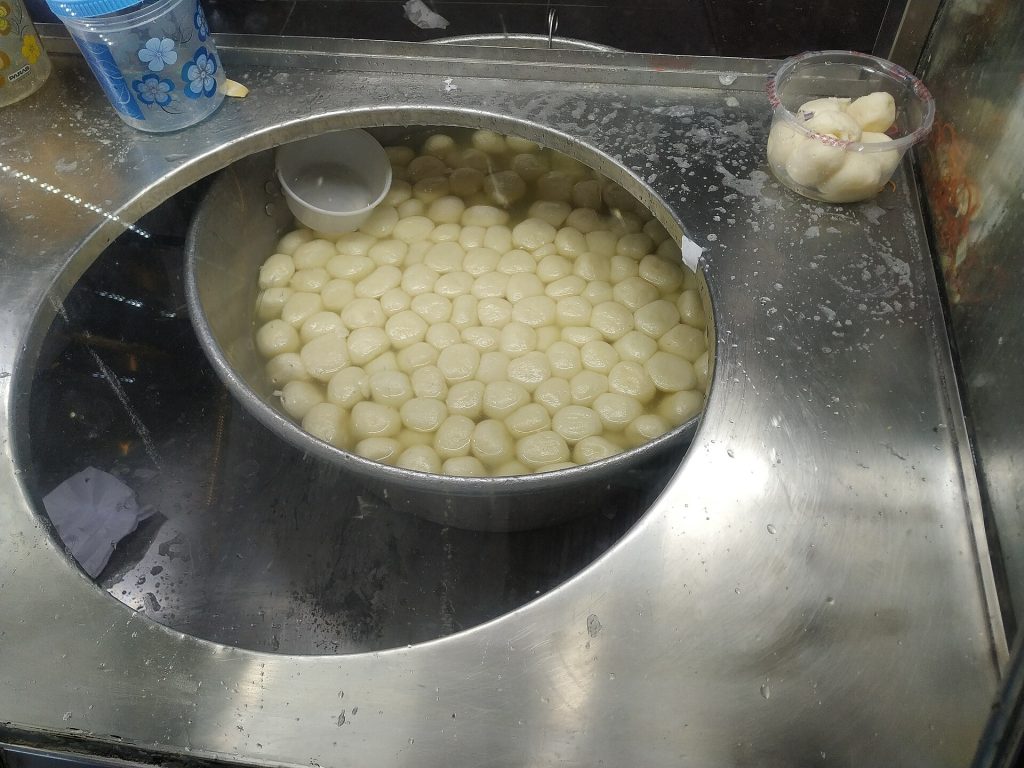
Bengali sweets are a separate discipline, built on chhena — fresh curdled milk solids — rather than the khoya and flour of most Indian sweets. Rosogolla, sandesh, mishti doi, nolen gur in winter when the date palm sap is running.
Chhena does not travel well, does not keep, and does not forgive a hot afternoon. Any sweet course worth eating in Bengaluru is made the same day, close by. This is one of the few places where local production is not a nice-to-have but the entire proposition.
The four ways to eat Bengali food in this city
Depending on what you want, the answer is different.
Somebody’s home
Still the best Bengali food in Bengaluru, and still the hardest to get an invitation to. If you have a Bengali colleague, express an interest in shukto. It works more often than you would think.
A restaurant
A restaurant gives you a plate, an afternoon and no logistics. It is the right way to find out whether you like a cuisine before you commit to feeding forty people with it. Our own restaurant at Bhartiya City exists largely for this: people come once out of curiosity and come back with their parents.
A puja or a community event
Bhog is a genuinely different experience from restaurant food — simpler, strictly vegetarian, cooked in enormous quantities and served with more feeling than finesse. If you get the chance during Durga Puja, take it.
Catering
When the occasion is yours — a wedding, an annaprasan, a company lunch, a housewarming — catering is the only option that gives you the full sequence at your own table. It is also where the most can go wrong, which is why we wrote a separate piece on how to choose Bengali caterers in Bengaluru and what questions to ask before you pay a deposit.
If you are ordering for the first time
Start smaller than you think. A ten-dish spread cooked properly beats an eighteen-dish spread that arrives lukewarm. Ask what is seasonal, ask what the kitchen cooks most often, and let those two answers shape the menu rather than picking dishes off a list because you recognise the names.
What to order the first time
If you have never eaten Bengali food and want a fair test of it, this is the order we would suggest.
- Begun bhaja — aubergine, salt, turmeric, shallow fried. Four ingredients, nowhere to hide.
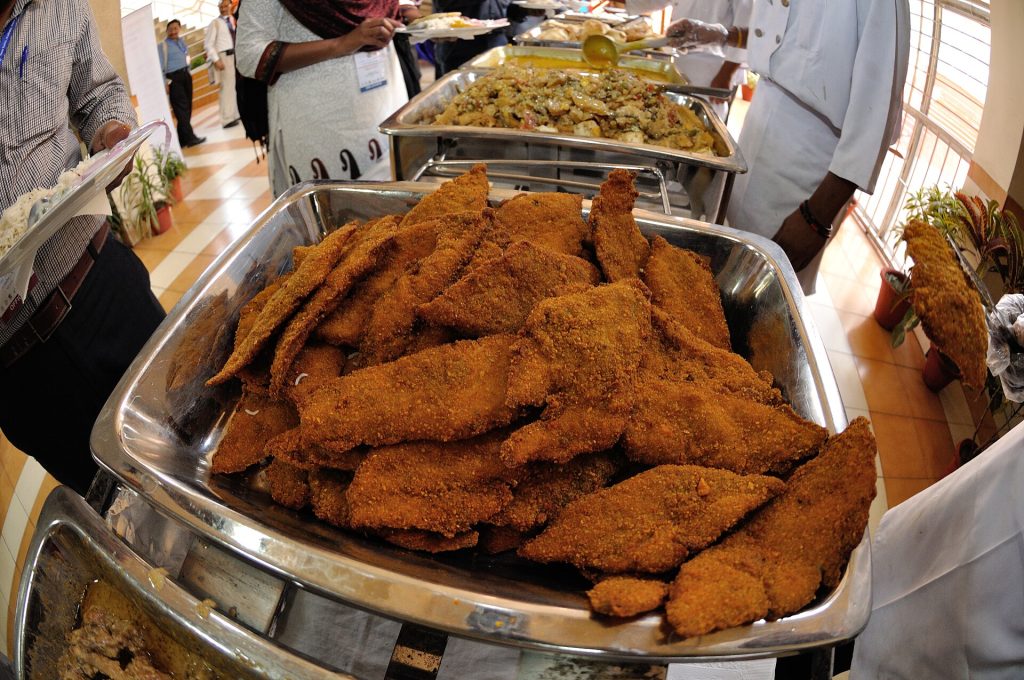
- Fish fry — crumbed bhetki, served with kasundi. The friendliest possible introduction to Bengali fish.
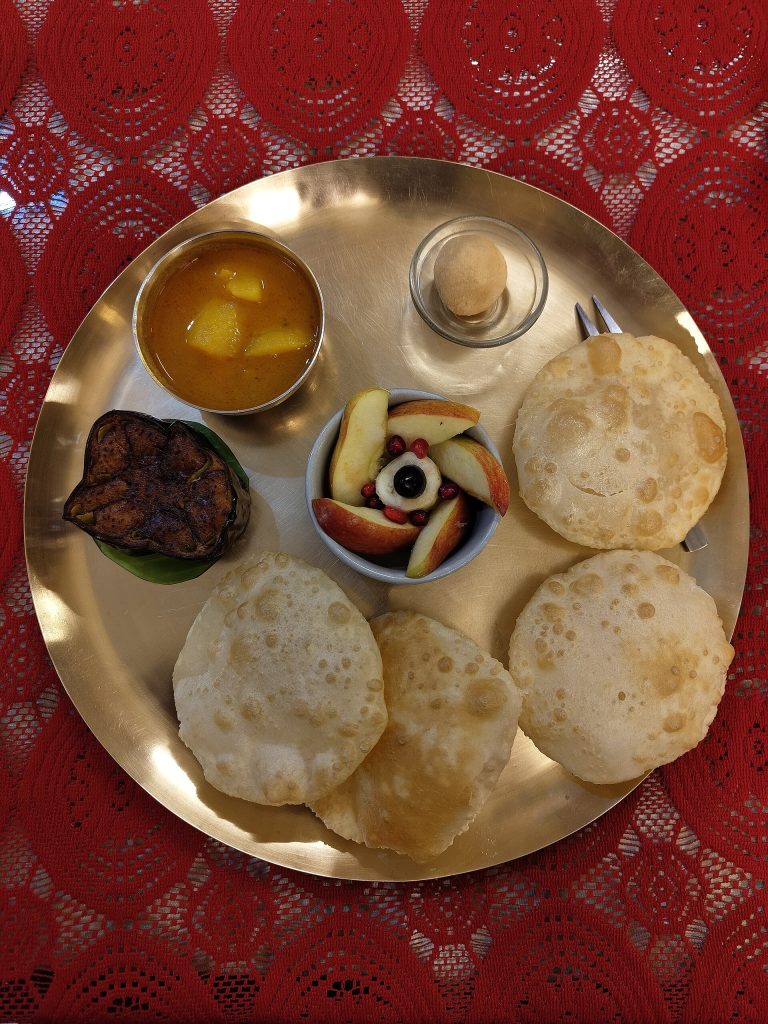
- Cholar dal with luchi — split chickpea lentils with coconut and raisin, and a puffed white flour bread. Sweet, festive, entirely unlike any dal you have had.
- Kosha mangsho — mutton cooked down slowly until the gravy clings. The dish most likely to make a non-Bengali order Bengali food again.
- Mishti doi — sweetened yoghurt set in an earthen pot. Finish here.
Leave shukto for the second visit. It is a magnificent dish and an acquired taste, and asking someone to start with a bitter course is how you lose them.
Ordering Bengali catering: what actually matters
Most of the real decisions in Bengali food catering are made before anyone thinks about individual dishes.
The event decides the menu
A wedding menu leads with fish and meat and treats the sweet course as generous by obligation. A puja bhog cannot contain onion, garlic, fish, meat or egg. An office lunch needs a vegetarian main that stands on its own and food that holds at a counter through a staggered lunch hour. A housewarming needs the traditional sequence kept whole even at twenty guests.
These are not preferences. They are the rules the occasion carries, and a caterer who treats them as options will eventually serve the wrong thing at the wrong event. Our own menus are built event by event for exactly this reason — you can see the full menu and the ready-made spreads for each occasion.
Volume changes what is possible
Some dishes survive being cooked for eight hundred people. Many do not. Anything that has to be served the moment it leaves the pan — a delicate paturi, a fish fry at its best — is a different proposition at scale than at a family lunch.
The honest approach is to choose dishes that hold well and cook those properly, rather than promising the full restaurant repertoire to a banquet hall and delivering a compromised version of all of it.
Vegetarians are not an afterthought
Bengali cooking has a deep vegetarian repertoire — the entire niramish tradition exists for widows, for puja, for fasting days — and it is far more interesting than the single paneer dish that usually gets added at the end of a menu. Dhokar dalna, shukto, chhanar dalna, echorer dalna. A Bengali spread with a serious vegetarian side is not a concession; it is the cuisine showing its range.
A short vocabulary
Useful when you are reading a menu and do not want to ask.
- Bhaja — fried. Usually a vegetable, sliced and shallow-fried.
- Bhapa — steamed, often in mustard paste.
- Paturi — wrapped in banana leaf and steamed or grilled.
- Kosha — slow-cooked until the gravy reduces and clings.
- Jhol — a light, thin curry, often with potato.
- Jhal — a thicker, hotter one.
- Dalna — a medium-bodied curry, usually vegetarian.
- Niramish — without onion or garlic, and without fish, meat or egg.
- Posto — poppy seed paste, and the dish built on it.
- Kasundi — fermented mustard sauce. Sharp. Excellent. Use less than you think.
The year has a menu of its own
Bengali cooking is seasonal in a way that is easy to miss if you only ever meet it in restaurants, where the card stays the same in January and June. At home, and at any kitchen cooking properly, the year moves the menu around.
Summer
Bengaluru summers are mild by Kolkata standards, which is its own small mercy, but the logic still applies. Summer cooking turns light and sour. Tok dal with raw mango, aam pora shorbot made from charred green mangoes, plain jhol with potato and a single piece of fish rather than anything heavy or reduced. Gondhoraj lebu — the fragrant Bengali lime that smells of coriander and citrus at once — goes into everything, and the difference between a kitchen that has it and one that substitutes ordinary lime is immediate.
Monsoon, and the hilsa argument
Ilish is a monsoon fish and everything about eating it is contested: which river, which weight, how to cut it, whether to steam it in mustard or fry it and drink the oil with rice. The season is short and the good fish is expensive, and a Bengali family will spend more on one ilish in July than on a week of ordinary shopping, entirely without embarrassment.
Khichuri belongs to this season too — rice and dal cooked together, eaten on wet afternoons with begun bhaja and an omelette. It is the most comforting food in the repertoire and, not coincidentally, the food served as bhog when several hundred people need feeding at once.
Winter
Winter is when Bengali cooking gets extravagant. The date palm sap runs and becomes nolen gur, which turns up in sandesh, in payesh, in a mishti doi that tastes entirely different from its summer version. Cauliflower, peas and new potatoes arrive and go straight into everything. Kosha mangsho, too heavy for June, makes sense again.
If you are choosing a date for an event and the menu matters to you, a December or January wedding gets a noticeably better spread than an April one. Nobody will tell you this. It is true anyway.
Bengali and North Indian on the same table
Almost every Bengali event in Bengaluru now feeds a mixed room. There are colleagues, in-laws from other states, children who grew up here and would rather have a paneer tikka than a shukto. Pretending otherwise produces a beautiful menu that half the room does not eat.
The workable answer is not fusion. It is two cuisines running in parallel, each cooked on its own terms. A Bengali sequence for the people who came for it, a North Indian line for the people who did not, and no dish trying to be both. We cook both for exactly this reason, and keep them as separate lists rather than a single blended one — a menu can draw from either, or from both, without either losing its shape.
What does not work is the hybrid that has become common at Bengaluru banquets: a Bengali name on a North Indian gravy. Chicken cooked in a standard restaurant base and called kosha, or a paneer dish with a handful of panch phoron thrown in at the end. It satisfies nobody and quietly teaches a whole room that Bengali food is unremarkable.
Five ways people get it wrong when ordering for a crowd
These come up often enough to be worth listing plainly.
1. Ordering by dish count
A twenty-eight dish menu sounds generous and frequently eats worse than a sixteen-dish one. Past a certain point every extra dish costs attention in the kitchen and space on the plate. Ask what the kitchen can cook well at your guest count, not how many items it can list.
2. Treating the sweet course as optional
At a Bengali event, running out of sweets before the last table has been served is the thing people remember and mention for years. Budget the sweet course as a course, not as a garnish.
3. Forgetting the bitter opener at a ceremonial meal
At a wedding, an annaprasan or a housewarming, shukto at the start is not decoration. Older guests will look for it. Its absence reads as a shortcut.
4. Assuming fish means one fish
“Fish curry” on a quotation tells you nothing. Ask which fish, cut how, cooked how. Bhetki, rohu, katla, prawn and ilish are five different propositions in price, availability and handling.
5. Leaving the vegetarians to the caterer’s imagination
Give a real number. “Some vegetarians” becomes one paneer dish. Twenty confirmed vegetarians becomes a proper niramish line, and the whole menu improves as a result.
One practical note on numbers
Bengali portions are small and numerous, so per-head quantities behave differently from a North Indian buffet. This is usually the first thing a caterer who has not cooked Bengali food at scale gets wrong, in either direction — either running short on rice, or producing enough fish for twice the room.
Where this leaves you
Bengali food in Bengaluru is in a better position than it has been in at any point in the last twenty years. There are enough people who grew up on it to keep the standards honest, and enough people discovering it to make it worth cooking properly.
What it still asks of you, as an eater, is a little patience with the sequence. Bengali cooking rewards people who let it unfold in the order it was built for. Eat the bitter thing first. Keep the portions small and take more. Leave room for the sweet course, because the sweet course is not an afterthought in this cuisine — it is frequently the point.
And if you are feeding other people rather than yourself, the useful next reading is our guide to which Bengali dishes suit which occasion, which goes course by course through what to serve at a wedding, a puja, an office lunch and a dinner at home.
Questions people actually ask
Where can I find authentic Bengali food in Bengaluru?
Bengali food in Bengaluru now runs from home kitchens taking a handful of orders a week to full restaurants and catering kitchens. BongKnot cooks both: a restaurant at Bhartiya City on Thanisandra Main Road, and Bengali catering for events across the city.
Is Bengali food spicy?
Generally no, not in the chilli-heat sense. Bengali cooking leans on mustard, poppy seed, panch phoron and ginger rather than heat, and most dishes are mild enough for guests who do not eat spicy food.
What makes Bengali food different from other Indian cuisines?
The sequence. A Bengali meal is served in courses on one plate, running from a bitter opener through dal and vegetables to fish, then meat, then chutney and a sweet. Freshwater fish, mustard oil and chhena-based sweets are the other distinguishing marks.
Do I need to book Bengali catering in Bengaluru in advance?
For weddings and large events, yes, usually three to six months ahead, because the November to February season fills early. Smaller gatherings are generally workable with four to six weeks of notice.
Bring the Bengali table to your event
BongKnot caters Bengali and North Indian food across Bengaluru, from a seven-guest dinner to a wedding. Send us the date and the guest count.
Keep reading
From Shukto to Kosha Mangsho: A Guide to Bengali Food for Every Occasion
A Bengali meal is a sequence, not a spread. What each course is for, and how the right menu changes from a wedding to a puja to a Sunday lunch.
Read more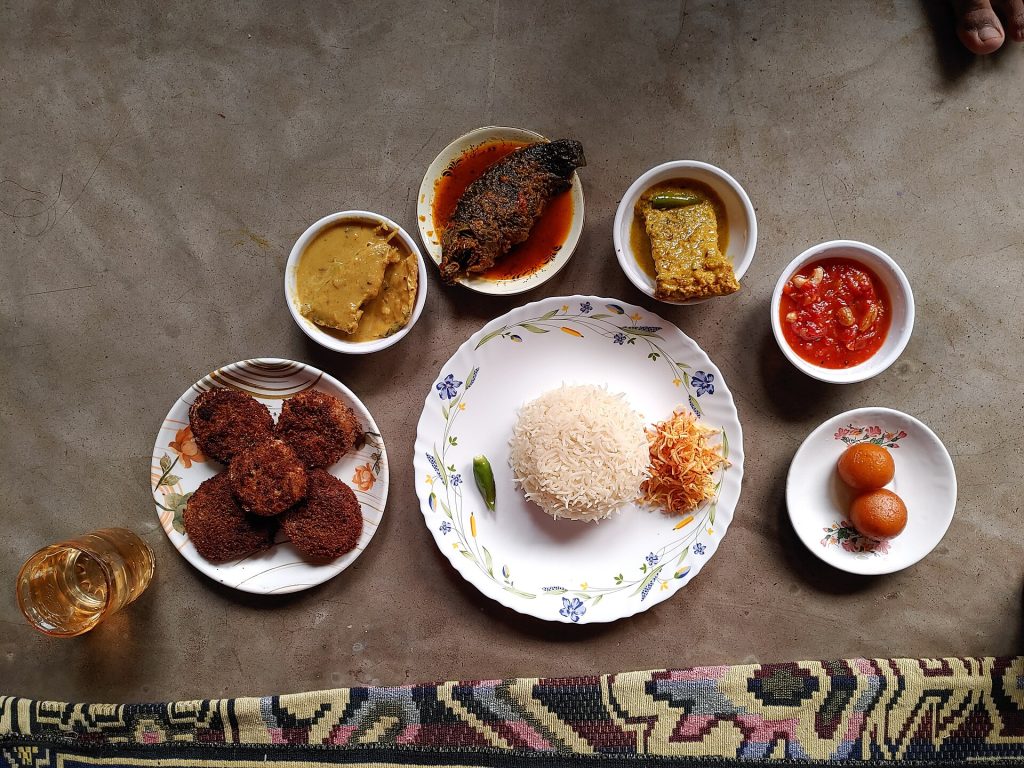
How to Choose the Best Bengali Caterers in Bengaluru for Your Next Celebration
The questions worth asking, how to read a quotation line by line, and the warning signs that are easy to miss until the day itself.
Read more